
KS Learning can provide extra lessons for maths from gcse maths tutors in London and help with gcse maths past papers, gcse maths revision notes, and gcse maths revision worksheets. Maths private tuition at its tuition centre can improve maths knowledge and performance through maths lessons, mathematics tutorials and maths tuition Twickenham.
| Question | Answer |
|---|---|
| What is a conductor of heat? | a material that allows heat to travel through it from one end to the other |
| Which elements are the best conductors of heat? | the metals |
| Explain thermal conductivity. | the higher the thermal conductivity of a material, the higher the rate of energy transfer (joules per second) through it |
| Name 2 conductors. | steel and copper |
| Name a practical use in the home of a conductor. | the radiators of the central heating system |
| Why are barbecue forks not 100% metal? | the heat from the fire would travel to the handles making it impossible to hold them |
| What is an insulator of heat? | a material that prevents heat travelling through it |
| Name two insulators. | plastic and wood |
| Which elements are the best insulators? | the non-metals |
| Compare the thermal conductivity of conductors and insulators. | materials that have low thermal conductivity tend to be good insulators and materials that have high thermal conductivity tend to be good conductors |
| Name the factors that affect the energy transfer per second through a layer of insulating material. |
• the temperature difference across the material • the thickness of the material • the thermal conductivity of the material |
| How does the thickness of an insulator affect its use? | the thicker the insulator, the greater the insulating effect i.e. the lower the rate of energy transfer through it |
| How does the thermal conductivity of an insulator affect its use? | the lower the thermal conductivity, the better the insulator |
| Name an item of clothing designed for insulation of heat? | the jumper is designed to retain body heat that would otherwise escape into the environment |
| Name a household use of insulation? | the vacuum in double glazed windows |
| Why do many homes in London insulate their lofts? | to reduce the loss of heat during cold weather which keeps the house warmer and reduces the cost of heating |
| Question | Answer |
|---|---|
| Why does sunlight make people feel warm? | because it contains infrared radiation |
| What are electromagnetic waves? | electric and magnetic waves that travel through space |
| List the members of the electromagnetic spectrum. | gamma rays, x-rays, ultraviolet rays, visible light, infrared, microwave, radio waves |
| How does wavelength vary across the visible light spectrum? | wavelength increases from blue to red light |
| Are infrared waves longer or shorter in wavelength compared to visible light? | infrared waves are longer in wavelength than visible light |
| What types of electromagnetic radiation does the sun emit? | all types |
| What types of electromagentic radiation reaches the earth from the sun? | mainly visible light and infrared with some ultraviolight waves as the atmosphere blocks all the other types of radiation from the sun |
| What does a prism do to a narrow beam of white light? | it splits the beam into the colours of the visible spectrum |
| Where is infrared on the spectrum? | between red visible light and microwaves |
Describe what happens in the following experiment.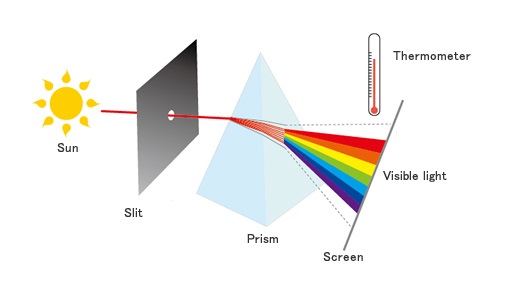
|
The experiment demonstrates the presence of infrared light • the prism splits the sunlight into its components • the visible part of sunlight is split into the colours in white light • sunlight contains invisible light namely infrared and ultraviolet • the infrared light falls on the thermometer • the temperature of the thermometer increases because of the warming effect of infrared light |
| How do cats see in the dark? | their eyes are able to 'see' infrared radiation |
| Why can cats see clearly in the dark? | because all objects emit infrared radiation |
| How does an infrared camera take pictures in the dark? | as all objects emit infrared radiation and an infrared camera can detect infrared, it can take pictures in the dark |
| How does temperature affect infrared radiation? | the higher the temperature, the more infrared radiation is emmitted in a given time |
| Which items emit infrared radiation? | all bodies no matter what their temperature, emit infrared radiation |
| Which items absorb infrared radiation? | all bodies no matter what their temperature, absorb infrared radiation |
| What is happening to a body at constant temperature in terms of infrared radiation? | it emits infrared radiation at the same rate and time as it absorbs infrared radiation |
| What is a perfect black body? | it is an object that absorbs all the radiation that hits it i.e. it does not reflect or transmit any radiation |
| Is there a relationship between how a body emits and how it absorbs? | yes - a good absorber is also a good emitter, and a poor absorber is also a poor emitter |
| What is the perfect emitter? | a perfect black body |
| What is the perfect absorber? | a perfect black body |
| How effectively does a good absorber emit radiation? | a good absorber is also a good emitter |
| What is the radiation emitted by a perfect black body called? | black body radiation |
| What other bodies emit or absorb radiation as effectively as a perfect black body? | no other object emits or absorbs radiation as effectively as a perfect black body |
| What happens to the amount of infrared radiation emiited by a body when its temperature increases? | the higher the temperature of an object, the more infrared radiation it emits |
| What does a body at a constant temperature emit? | an object at a constant temperature emits radiation across a continuous range of wavelengths |
| Does a body at a constant temperature emit equal amounts of each wavelength? | No, the intensity of the radiation is highest at one wavelength falling off either side |
| What happens to the radiation emitted if the temperature of a body is increased? | the intensity of each wavelength increases and the peak moves to a shorter wavelength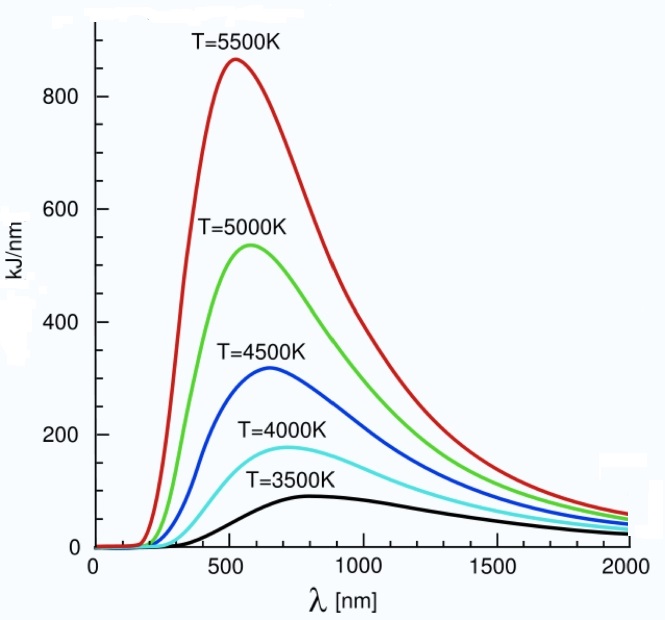
|
| Question | Answer |
|---|---|
| Which objects emit infrared radiation and when? | all objects at all times regardless of their temperature |
| Which objects absorb infrared radiation and when? | all objects at all times regardless of their temperature |
| Does an object at a constant temperature emit infrared radiation? | yes, the temperature remains constant because it emits and absorbs infrared radiation at the same rate |
| What is the role of infrared radiation in an object whose temperature is increasing? | the object is absorbing infrared radiation faster than it is emitting infrared radiation |
| Why do rescuers use light, shiny blankets rather than convential ones? | a light, shiny surface emits a lot less radiation than a dark, matt surface so the shiny, light blanket keeps the person warmer as less infrared radiation is emitted |
| What is the effect of infrared radiation and light from the sun on the earth? |
• if it absorbs more than it reflects and emits, then the temperature will increase • if it emits and reflects more than it absorbs, then the temperature will decrease |
| What reflects infrared and light away from the earth? | both the earth itself, and the atmosphere |
| What emits infrared and light radiation from the earth? | both the earth itself, and the atmosphere |
| What would the impact on the earth be of losing its atmosphere? | the temperature of the earth would drop to around -180 °C |
| What is the temperature of the moon at night? | the temperature of the moon at night is around -180 °C |
| Why would the temperature of the earth fall at night without an atmosphere? | because the earth would not be absorbing light from the sun (it is night) but only emitting infrared radiation |
| Name 3 greenhouse gases. | carbon dioxide, water vapour, and methane |
| How do greenhouse gases affect the temperature of the earth? |
• the ground becomes warm and emits longer wavelength infrared radiation • the gases absorb the longer wavelength infrared radiation emitted by the ground • after absorbing the infrared radiation, the gases emit it back out again towards the earth • this prevents the longer wavelength infrared radiation from escaping into space • this warms the earth up, making it warmer than it would be without the atmosphere |
| Question | Answer | ||||||||||||||||||||||||||||||||||||||||||||
|---|---|---|---|---|---|---|---|---|---|---|---|---|---|---|---|---|---|---|---|---|---|---|---|---|---|---|---|---|---|---|---|---|---|---|---|---|---|---|---|---|---|---|---|---|---|
| When an object is heated, what does its rise in temperature depend on? |
• the amount of energy supplied to it • the mass of the substance • what the substance is |
||||||||||||||||||||||||||||||||||||||||||||
| Which would heat up faster in the sun - steel or concrete? | steel | ||||||||||||||||||||||||||||||||||||||||||||
| Why does steel heat up faster than concrete? | steel has a lower specific heat capacity than concrete | ||||||||||||||||||||||||||||||||||||||||||||
Organise the substances in order from heating up fastest to slowest
|
the lower the specific heating capacity, the faster it will heat up
|
||||||||||||||||||||||||||||||||||||||||||||
| Define specific heat capacity. | the specific heat capacity of a substances is the energy needed to raise 1 kg of the substance by 1 °C | ||||||||||||||||||||||||||||||||||||||||||||
| What are the units of specific heat capacity? | the joule per kilogram degree Celsius J/kg°C |
||||||||||||||||||||||||||||||||||||||||||||
| What is the effect of the mass of an object about the rate at which it heats? | the greater the mass of the object, the slower it heats up | ||||||||||||||||||||||||||||||||||||||||||||
| Write the formula for the energy needed to increase the temperature of a substance. | ΔE = m x c x Δθ | ||||||||||||||||||||||||||||||||||||||||||||
| State the word formula for the energy needed to increase the temperature of a substance. | energy transfered = mass x specific heat capacity x temperature change | ||||||||||||||||||||||||||||||||||||||||||||
| How much energy is required to raise the temperature of 2kg of water by 3 °C? | ΔE = m x c x Δθ = 2 x 4200 x 3 = 25200 J |
||||||||||||||||||||||||||||||||||||||||||||
| How does a storage heater work? |
• a storage heater uses electricity at night to heat special bricks • the bricks have a high specific heat capicity so retain a lot of energy • the bricks warm up slowly when the electricity is on, and cool down slowly when it is off • the bricks heat up while electricity is cheap, and release their heat later when it is needed |
||||||||||||||||||||||||||||||||||||||||||||
| How can the specific heat capacity of a metal block be measured in a laboratory? |
• use a top pan balance to measure the mass of the object • connect a heater to the metal block • use a joulemeter to measure the energy supplied to the block ΔE • use a thermometer to measure the change in temperature of the block Δθ • then calculate specific the heat capacity, c = ΔE / (m x Δθ) |
| Question | Answer |
|---|---|
| How are homes heated? |
• electric heaters • gas heaters • gas central heating • oil central heating • solid fuel in a fireplace |
| Name 5 measures that can be taken to reduce the rate of energy transfer from a house. |
• loft insulation • cavity wall insulation • aluminium foil between a radiator panel and the wall • double glazed windows • thicker bricks with lower thermal conductivity |
| How does loft insulation help reduce the rate of energy transfer from a house? | many houses lose a lot of energy through the roof; the insulation used to line the loft reduces the rate of energy transfer through the roof |
| Name a good material for loft insulation. | fibreglass |
| How does fibre glass insulate? | the material of the fibres is an excellent insulator and the air gaps between the fibres trap heat preventing it from being lost |
| What is the impact of the number of layers of insulation on heat loss? | the greater the number of layers of insulation, the lower the rate of energy transfer through the roof |
| What is cavity wall insulation? | rather than a single wall, there is an outer and an inner wall and the space between the two is filled with insulating materials |
| How is the insulation installed in cavity wall insulation? |
• first both walls are built • then the insulation is pumped into the space |
| What is the benefit of cavity wall insulation? | the insulation material pumped into the cavity is a better insulator than air reducting the loss od energy transfer through the walls |
| How does cavity wall insulation reduce energy loss? |
• the material itself is a good insulator • the cavity wall insulation traps the air in small pockets reducing the rate of transfer by conduction |
| How does aluminium foil between a radiator panel and the wall reduce the rate of energy transfer from a house to the surroundings? | it reflects radiation away from the wall back into the room reducing the rate of energy transfer from the house to the surroundings |
| What are double-glazed windows? | double-glazed windows have two panes of glass with dry air or a vacumm between them |
| How does glass in windows affect heat loss? |
• the thicker the glass, the slower the rate of energy transfer through it • the lower the thermal conductivity of the glass, the slower the rate of energy transfer through it |
| How can heat loss be reduced through brick walls? |
• using bricks with lower thermal conductivity • using thicker bricks • cavity wall insulation |
| How can solar panels help reduce heating expenses? |
• by providing electricty to run heaters • by heating water directly |
| How do solar panels work? | solar panels absorb infrared radiation from the sun and generate electricity or heat water |
| Where are solar panels installed and how? | solar panels are usually installed on the roof facing south to absorb as much infrared radiation from the sun as possible |
A good tutor can build the confidence of a learner enabling subject success
A private tutor can improve the skills a pupil needs to master a subject
Regular tutoring can drive progress and better results in school subjects
Support can help students and parents make the right academic decisions


